Work Research
Fog-mesh collectors for a Venus cloud sampler
Comparing three passive mesh designs for condensing fog droplets, on a modular rig built for the test.
A proposed balloon mission would sample the clouds of Venus with a passive mesh that condenses droplets. We tested whether two engineered meshes, Raschel and kirigami, collect more than a plain fiberglass pad. The plain pad won by a factor of six.
Why it matters for GNC. Designing a test that isolates one variable, and saying plainly what a single trial can and cannot show, is the same discipline a navigation filter's validation needs.
The problem
Part of the Venus cloud layer has temperatures and pressures mild enough that researchers ask whether it could host life. Mission concepts for measuring it include a balloon carrying a passive collector: a mesh that condenses cloud droplets so an instrument can analyze them. Our work supported Dr. Carr’s lab and an MIT-led mission study. We could not build a payload in six weeks, so we narrowed the question to one part of it: which mesh geometry collects the most water?
All three meshes resist sulfuric acid, so the comparison could later be repeated in Venus-like chemistry. Each catches droplets differently:
- Fiberglass pad (about 1 in thick): its dense fibers trap droplets, and gravity drains them.
- Raschel (laser-cut PTFE): slanted slots let small droplets merge as they slide down.
- Kirigami (folded, laser-cut Mylar): cuts and folds shed vortices that throw droplets together, if the flow is fast enough.
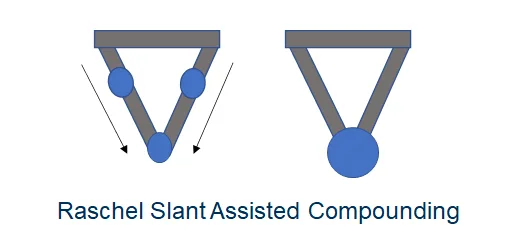
How a Raschel slot compounds small droplets into larger ones.
My part
Snigdha and I came up with the concept and did the literature review. I designed and built the test rig. All three of us ran the experiment, analyzed the data and wrote the results.
The rig
The rig had to be easy to carry and quick to re-mesh. A base plate carries a CNC-machined channel, 1 in wide, deepening from 0.25 in to 0.5 in so water runs down it, through a printed nozzle and into a covered collection box. Two laser-cut frames clamp the mesh with an eyebolt, nut and washer on each upright; slide-on spacers lift the frame for larger meshes than the ones we tested.
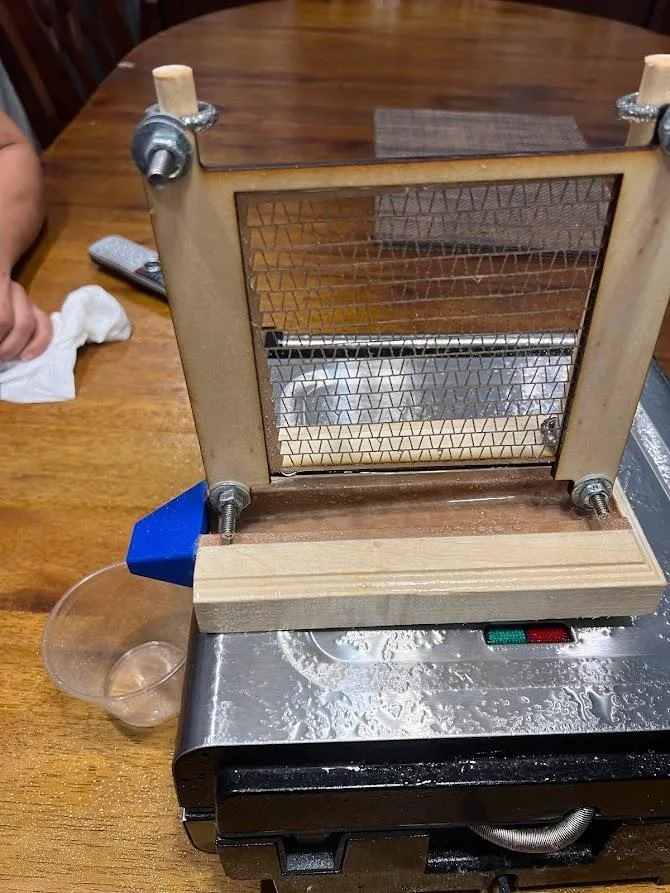
The rig with a mesh clamped in its frames.
I modeled the Raschel and kirigami patterns in SolidWorks as pattern features, using unit-cell dimensions from earlier studies, then tuned laser settings so the cuts wouldn’t burn the thin sheets. The kirigami then had to be folded by hand along etched lines.
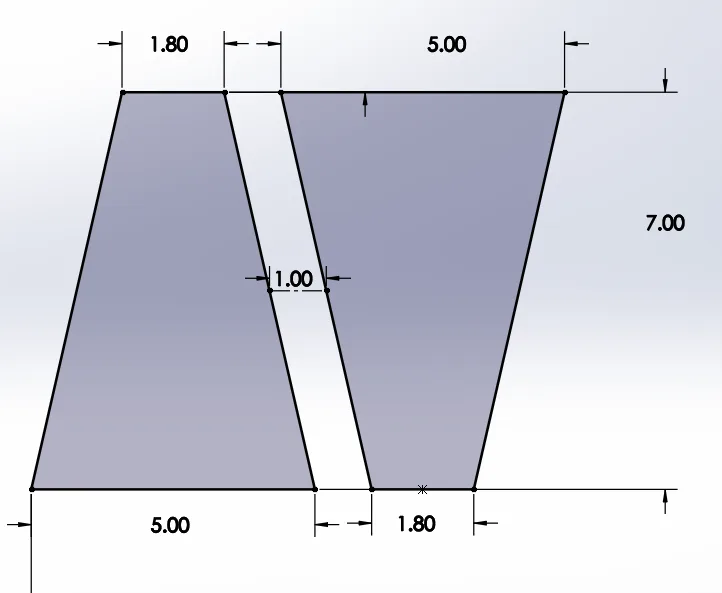
Raschel unit cell.
Dimensions in millimeters.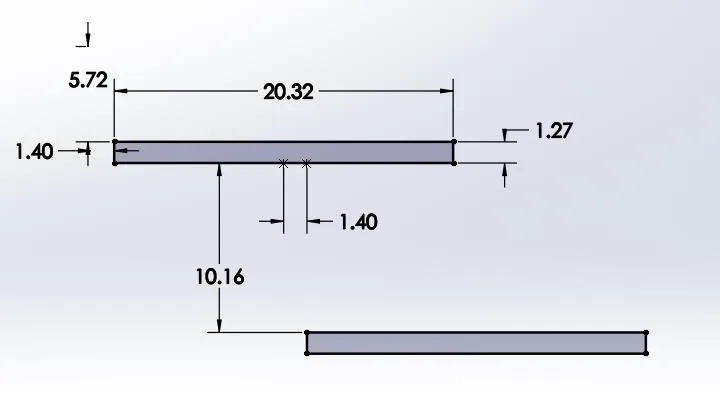
Kirigami unit cell.
Dimensions in millimeters.Method
A household humidifier fed through an ultrasonic atomizer made the fog. Lang’s equation gives the median droplet diameter from the atomizer’s drive frequency F:
The humidifier sat below the mesh and blew straight at it, approximating 100% relative humidity. Each trial ran on high until the 1,500 mL tank was empty, which took 10 to 13 hours. Efficiency is the water collected divided by the water dispensed.
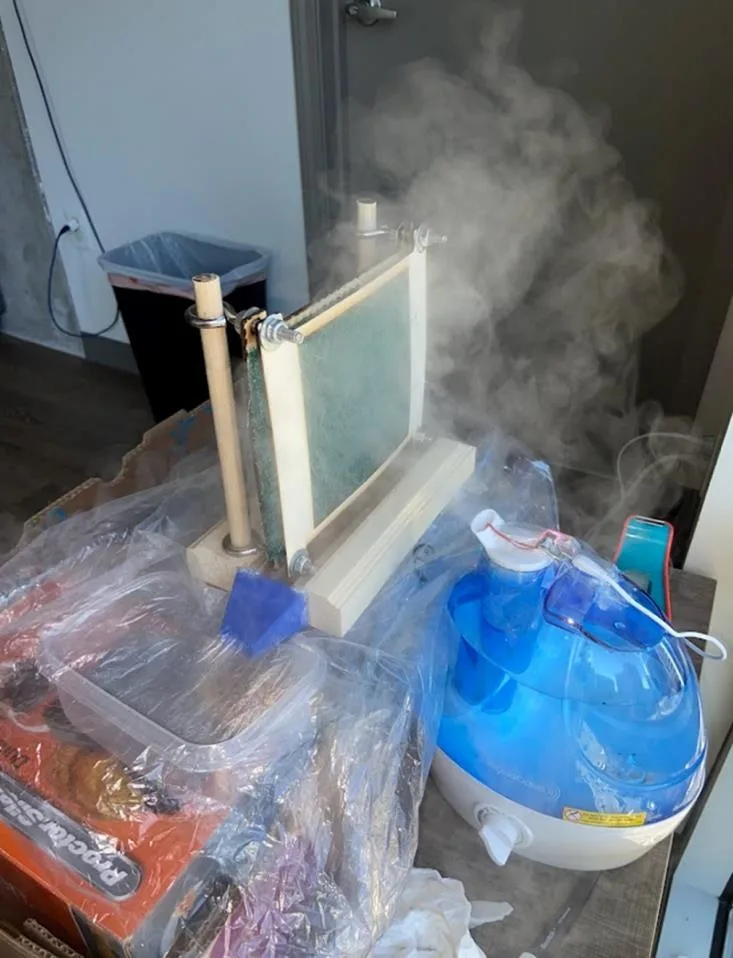
A trial in progress. Plastic wrap over the box keeps stray fog out.
Results
The fiberglass pad collected 171 mL (11.40%), the Raschel mesh 27 mL (1.80%) and the kirigami 10 mL (0.67%). The reference kirigami design was expected to reach 16.1%.
The likely reasons:
- The pad is about 250 times thicker than the 0.1 mm sheets, so it simply has far more fiber in the fog’s path. Droplets condensed across its whole face before draining.
- Raschel beat kirigami because its smaller unit cell gives more edge per square inch to collect on. Its result is also the least trustworthy, as the note below explains.
- Kirigami needs vortices, and vortex strength depends on flow speed. The humidifier’s gentle plume, which we estimated at about 0.2 m/s without measuring it, was probably too slow. Water dripped to the bottom of the kirigami first and only grew into drops there.
The Raschel trial ran first, with the collection box uncovered. Some of its 27 mL probably fell straight in from the fog, so its 1.80% is likely an overestimate. We covered the box for the other two trials.
One trial per mesh, so there is no estimate of trial-to-trial scatter. Flow rate wasn’t controlled (it averaged about 136 mL/h) and flow speed wasn’t measured. The meshes differ in material and thickness as well as geometry, so geometry’s effect isn’t isolated. Efficiency here is normalized by water dispensed, not by the flux through the mesh, so it isn’t comparable to field fog-collection figures.
Next time
We would scale the meshes up toward payload size, build a fog source with controllable droplet size and flow speed, and repeat each trial. The design we wanted to try next stacks thin layers that combine kirigami and Raschel features, to get the pad’s density with engineered geometry.
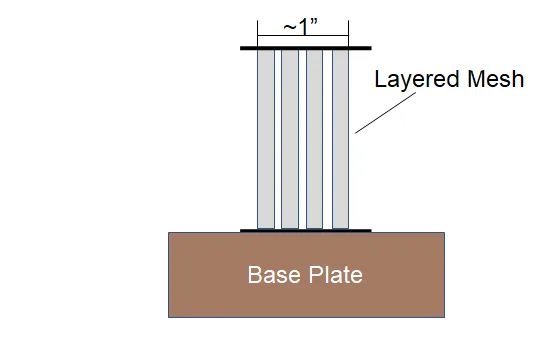
The layered hybrid mesh we proposed testing next.
Documents
- Final reportMuralikrishna, Nellutla and Singla, December 2022. 12 pages.