Adithya Muralikrishna, Aerospace engineer working toward guidance, navigation and control.

I hold a B.S. in aerospace engineering and an M.S. in computer science from Georgia Tech. My work so far covers orbit transfers and a cislunar mission design, decision support for space domain awareness, test rigs for sensors, and the control systems I work on today.

Now
Automation engineer at R.E. Mason, writing control logic and proving it on a simulation bench before it runs a plant.
Next
Spacecraft dynamics, estimation and control, starting with a simulator of my own.

See the work Read the CV

2 R⊕4 R⊕6 R⊕Δv₁Δv₂
Circular orbits, altitude in km
Δv₁
2.397 km/s
Δv₂
1.456 km/s
Total
3.854 km/s
Time of flight
5.29 h
Transfer a
24,471 km
Transfer e
0.7230
Plot 1. Hohmann transfer raising a circular orbit from 400 km to 35,786 km altitude: 2.397 plus 1.456 km/s, 3.854 km/s in total, 5.29 hours in transit. Two-body point-mass Earth (μ = 398,600.4418 km³/s²), coplanar circular orbits, impulsive burns; no J2, drag or third bodies. Checked against Vallado's Example 6-1 and an independent RK4 propagation.

Where the work sits

Guidance, navigation and control is a loop. Here is my work placed in it. Most of it sits at the ends, in dynamics and in deciding what a system should do; the dashed block is where my next projects go.

Guidance & supervision

Decide what the system should do next, by algorithm or by an operator.

Control & automation

Turn that intent into commands the hardware follows.

Dynamics & astrodynamics

How the vehicle or plant actually moves.

Measurement & test

What the instruments report, and how far to trust them.

Navigation & estimation

What the state most likely is, given noisy measurements.

Selected work

Four sheets that show how I model, design and test. Each one lists my part, the method and what didn't work.

Project

Orbital transfer calculator

A browser calculator for Hohmann transfers that plots the transfer and shows every intermediate step, tested with three undergraduate and three graduate aerospace students.

Date 2023–2025, 8 weeks
By A. Muralikrishna and Yuga Ojima, graduate students
Checked Dr. Karen Feigh
Status Prototype and formative study, n = 6

Students usually meet Hohmann transfers as formulas and static diagrams. We built a calculator that lets a student pick which quantities to give and which to find, plots the transfer, and steps through the intermediate calculations, then watched six aerospace students use it.

For GNC: The same vis-viva relations drive the plotter on this site, re-implemented and checked against Vallado's worked example and an independent numerical propagation.

Filed under Dynamics & astrodynamics, Guidance & supervision
Project

SDA decision support

Human-factors research on how operators analyze satellite maneuvers and triage anomalies, and what a decision-support system must do to help them.

Date Aug 2023 – May 2025
By A. Muralikrishna, graduate research assistant, in a multi-university team
Status Research role complete

Space domain awareness analysts have to explain what a satellite just did, a planned maneuver, a failure or something deliberate, from sparse tracking data. Within a multi-university research effort, I led the human-factors and decision-making side: what operators need from a decision-support system, written as requirements it can be tested against.

For GNC: Autonomy and GNC systems only help if the people supervising them can trust and check their output. This work sits at that boundary, on the same orbit-determination problem a navigation filter solves.

Filed under Guidance & supervision, Dynamics & astrodynamics

Project

STARS L1 platform

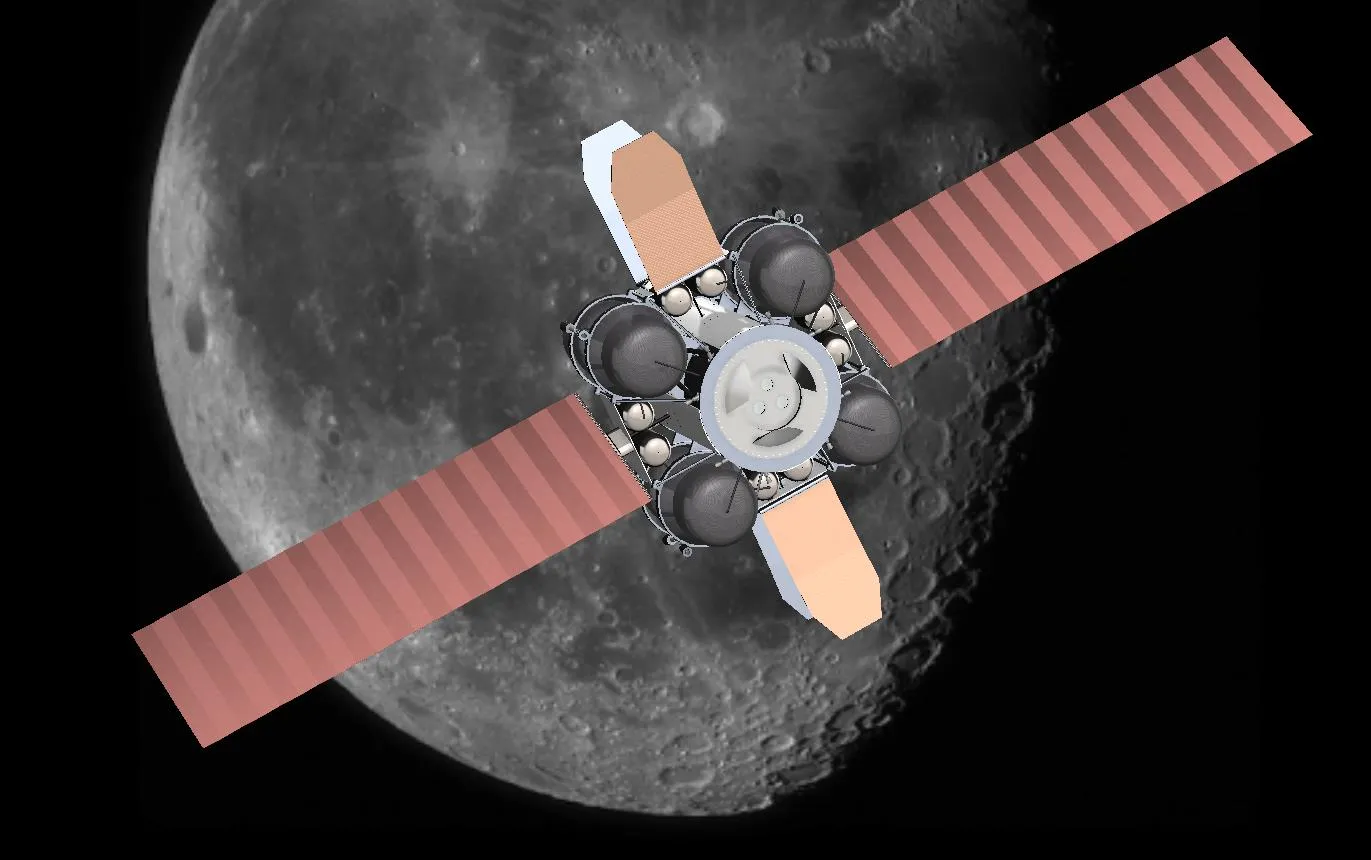
A ten-person mission proposal for a propellant depot and lunar communications relay in a halo orbit around the Earth–Moon L1 point.

Date Fall 2022, 12 weeks
By A. Muralikrishna and nine teammates, Georgia Tech
Checked Dr. Álvaro Romero-Calvo; Saumya Sharma
Status Proposal complete; concept study

Ten aerospace students sized a station in a halo orbit around Earth–Moon L1 that refuels lunar-bound spacecraft and relays data from the lunar south pole and far side, all closed around one Falcon Heavy launch.

For GNC: Choosing the halo orbit, sizing station-keeping thrust, picking attitude sensors and actuators, and placing relay satellites in frozen lunar orbits are the mission-level decisions that guidance and navigation work serves.

Filed under Dynamics & astrodynamics, Control & automation

Project

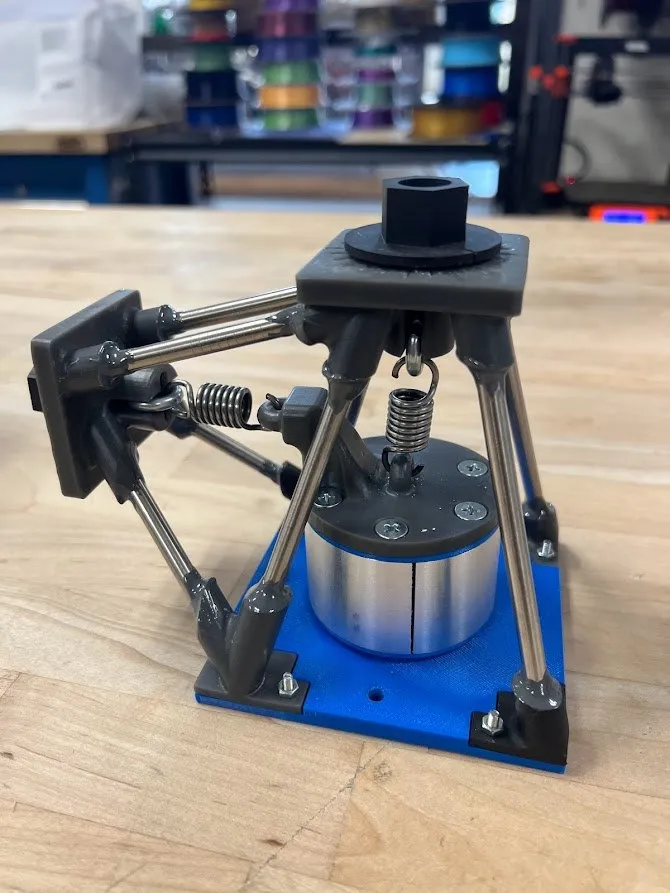
Six-axis load-cell rig

A compact fixture that applies known axial, transverse and moment loads to a strain-gauge load cell at the same time, so its error terms can be measured.

Date Fall 2022, 8 weeks
By A. Muralikrishna, undergraduate researcher, solo
Checked Dr. Juergen Rauleder
Status Built and proof-loaded; characterization not run

Wind-tunnel balances drift through creep, hysteresis, temperature and orientation, and a measurement is only as good as its calibration. I designed and built a rig that loads an Interface 6A40 six-axis load cell through two preloaded springs, in steps of known force, so those errors could be measured.

For GNC: An estimator is only as good as its sensor model. This rig exists to measure one: the error terms of a six-axis force sensor.

Filed under Measurement & test

All 12 entries in the register, including the fog-mesh experiment, coursework and every role.

Planned

Work I have scoped but not started. It moves into the register when there is something to show.

Spacecraft dynamics and GNC simulator

Proposed, not started

A configurable simulation environment for a single spacecraft: translational and rotational dynamics, the tools to estimate its state, and the algorithms to steer it.

  • Six-degree-of-freedom rigid-body dynamics with quaternion attitude and configurable mass and inertia
  • Gravity and force models with a choice of numerical integrators
  • Sensor and actuator models feeding a Kalman filter
  • Guidance and control laws, exercised by Monte Carlo runs
  • Validation against analytic solutions before any new feature is trusted

First milestone. Torque-free attitude motion checked against its analytic solution and against conservation of angular momentum and energy.

A possible later application is autonomous atmospheric entry, descent and landing.